Two regulators.
One record.
The privacy regulator wants erasure honoured and disclosures completed on time. The financial regulator wants KYC files retained, complaints logged, and incidents reported. Ghost is the workspace where both apply at once — with the lawful basis written down.
EU-hosted · Append-only audit log · Built to the same data-protection standards as the firms it serves.
The financial-services workflow
Intake. Reconcile. Redact. Defend.
A DSAR pulls from KYC, the ledger, complaints, and fraud screening. Erasure runs into AML retention. Incidents have two clocks. Ghost is the workspace where the response is assembled, the lawful basis is written down, and the audit trail survives both supervisors.
Step 01
Log and verify
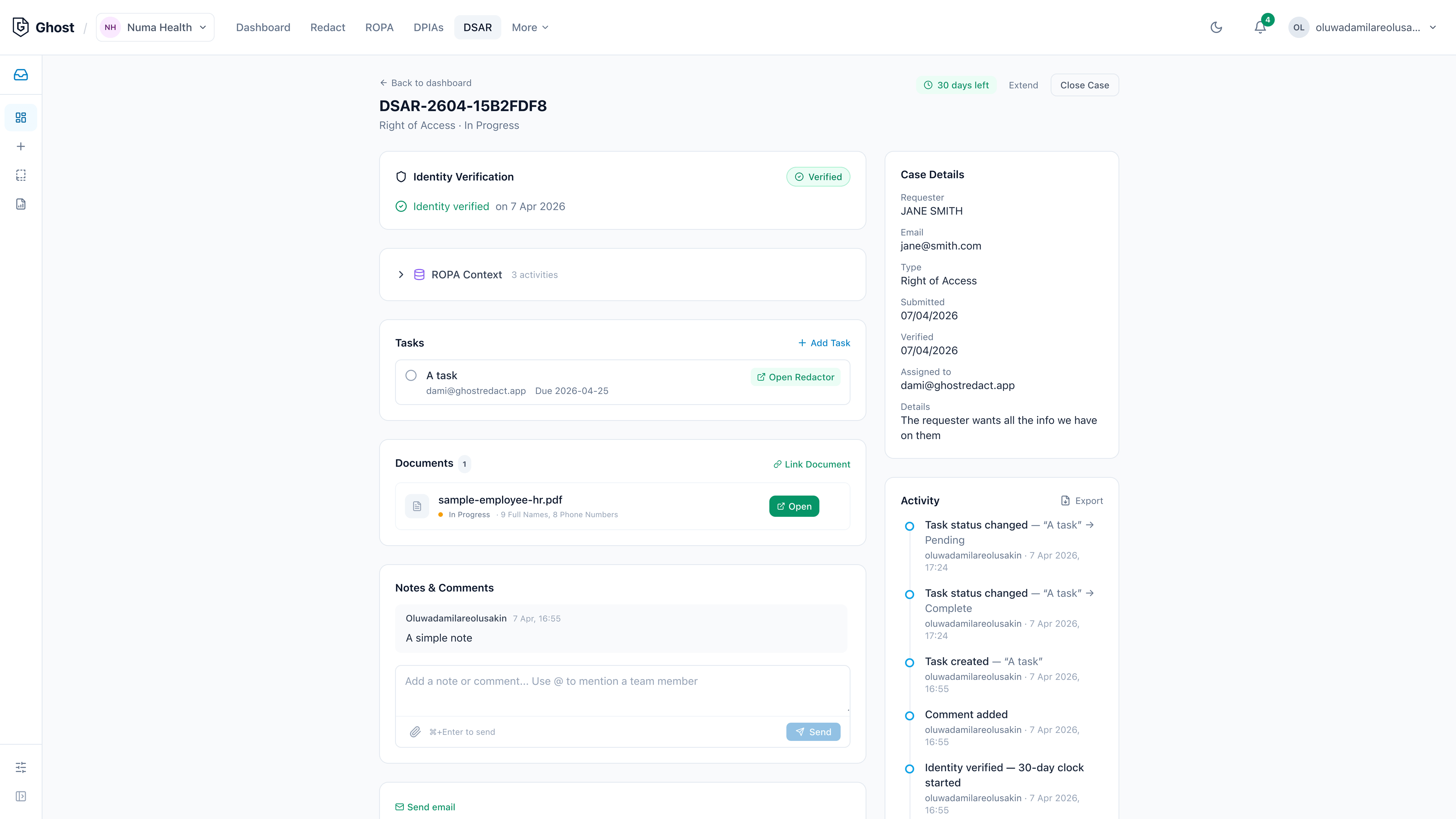
Intake the request through a branded form, verify identity before any disclosure, and start the Article 12 clock from the moment the request is identifiable.
Step 02
Pull across systems
Exports from KYC, the transaction ledger, complaints, fraud, sanctions screening, and any open-banking consent records. Ghost holds the case; operational systems remain the systems of record.
Step 03
Redact and apply lawful basis
Mask counterparty names, staff identifiers, and SAR-related material. Where AML retention restricts erasure, record the lawful basis under Art. 6(1)(c) on the case and link to the Article 30 entry.
Step 04
Deliver, evidence, both regulators
Send via a signed, time-limited link. Keep an append-only audit trail — exportable as evidence whether the privacy supervisor or the financial supervisor asks first.
Privacy request manager
Built for multi-system response packs.
Branded intake for customers and representatives, identity verification before any disclosure, task assignment across compliance, operations, and fraud teams, and the Article 12 deadline tracked automatically on every case.
- Branded intake for customers and representatives
- Identity verification before any disclosure
- Tasks assignable across compliance, ops, fraud
- Article 12 deadline tracked automatically
Redaction for regulated files
Counterparties out. SAR material out. Customer detail in.
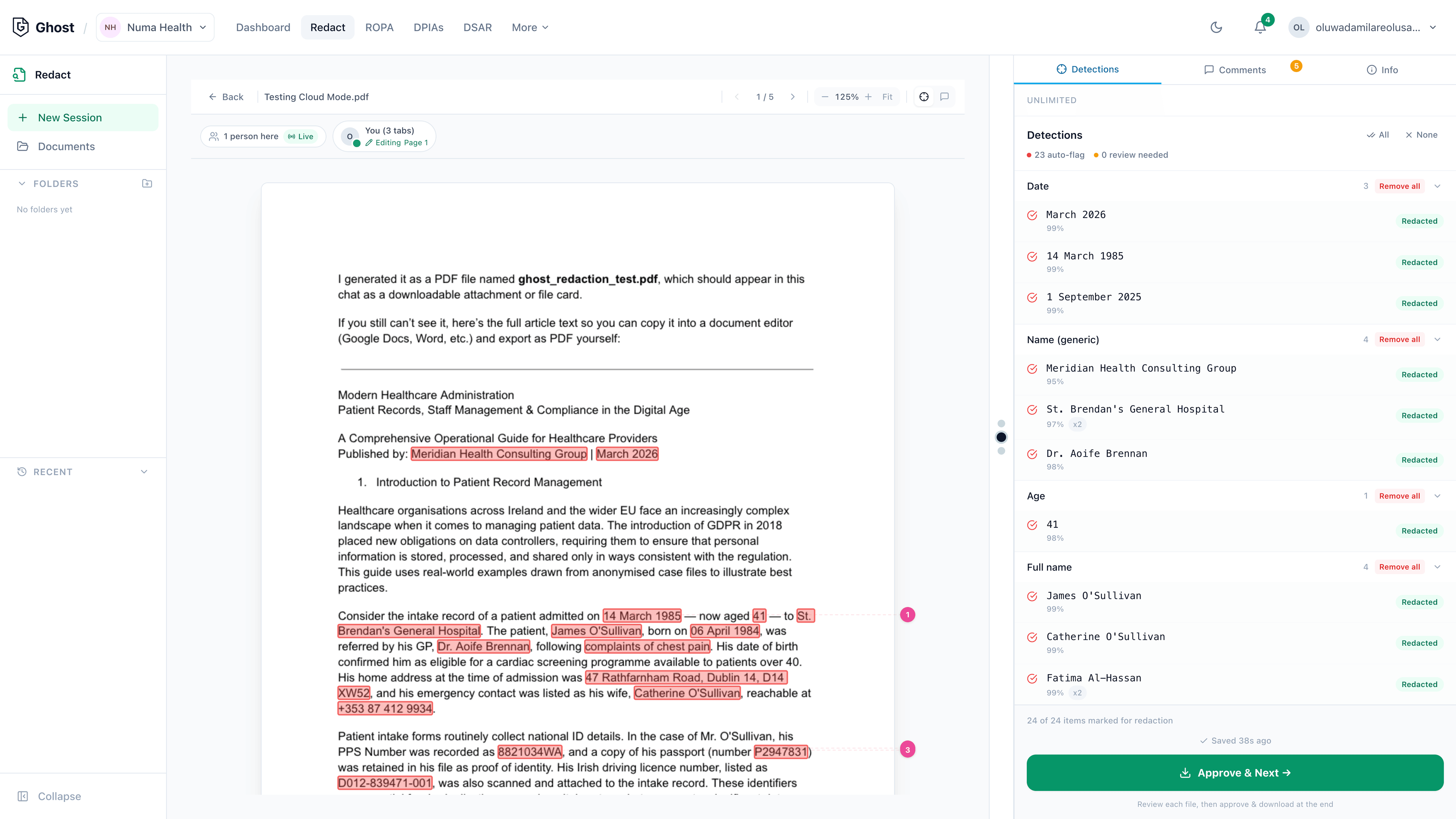
Upload KYC exports, transaction histories, complaints correspondence, and fraud-screening output. AI-assisted detection surfaces names, addresses, identifiers, and contact details for review. You accept, reject, or refine — and the rationale lands in the audit log.
- PDFs, CSV exports, scanned documents
- AI-assisted PII detection on Solo DPO and DPO Team
- Client-side rendering — files stay in your browser
- Rationale captured next to every redaction decision
Article 30, Breach, and Third-Party registers
Evidence that survives a supervisory visit.
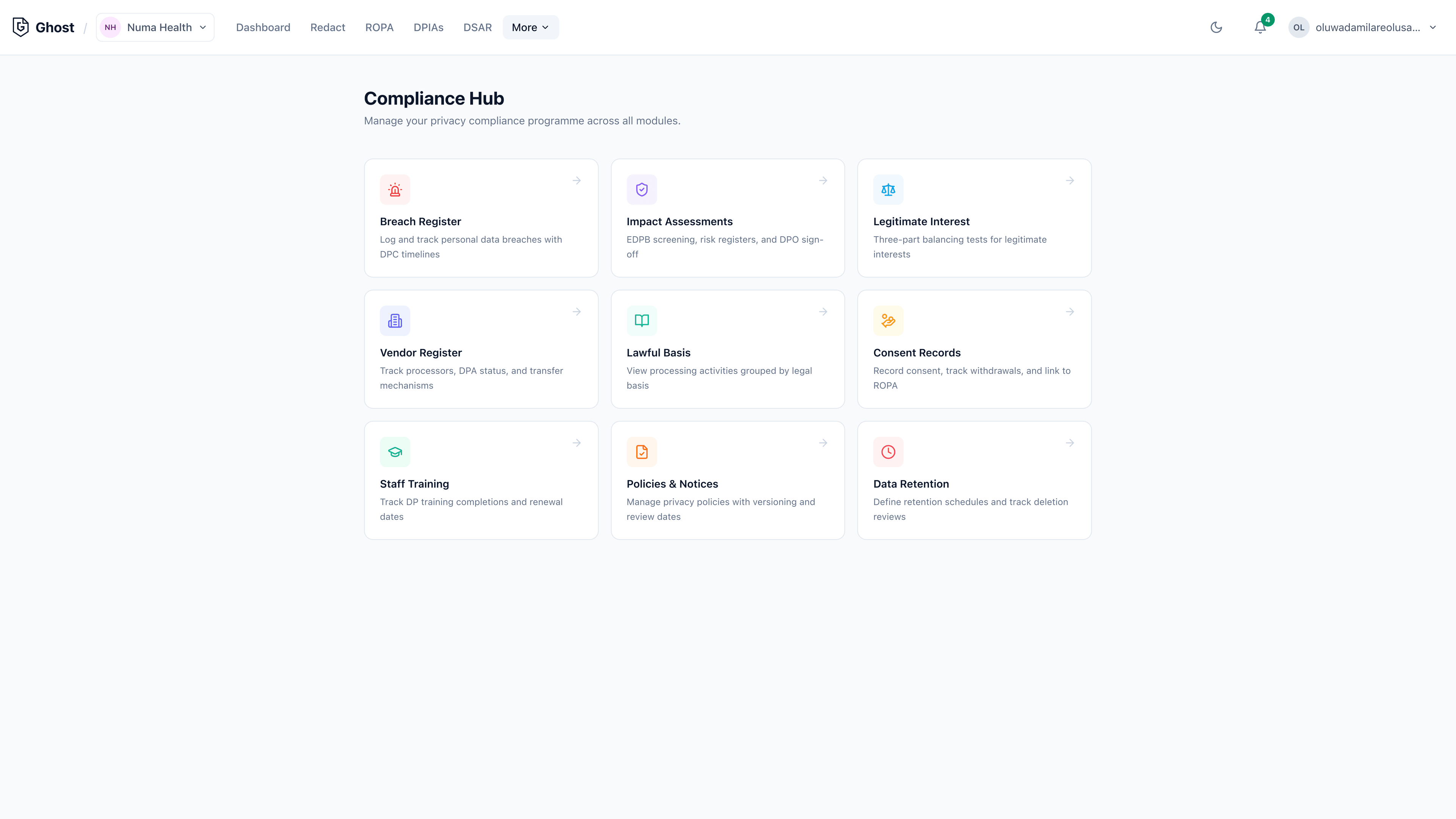
Records of processing for onboarding, transaction monitoring, marketing, employee data, and outsourced functions. Breach Register with the Art. 33 clock running. Third-Party Register for ICT and processor relationships. An append-only audit log on every record.
- Article 30 register with completeness score
- Breach Register with the Art. 33 clock per incident
- Third-Party Register for ICT and processor relationships
- Audit pack export when either supervisor asks
See it end to end
A short walk-through of the workspace.
Redaction, privacy requests, and the audit log — in about three minutes.
What financial-services teams ask us first
Three questions every regulated firm raises.
“Where does AML retention sit?”
Front and centre. Ghost records the lawful basis when retention restricts erasure, links the case to the Article 30 entry, and stores the customer-facing explanation. The legal obligation is on the record.
“Does this replace our core banking or KYC?”
No. Core banking, KYC, and complaints handling stay where they are. Ghost is the privacy ops layer beside them — for the request, the redaction, the response pack, and the audit trail.
“What about DORA and operational resilience?”
Ghost supports the privacy and incident workflows DORA touches; it does not certify against DORA or any sectoral standard. Operational resilience remains yours to defend — Ghost is one of the controls you point at.
Pricing
Plans for fintechs, lenders, payments, and banks.
Start free. Move up when procurement, scale, or supervisory scrutiny require it.
Free
Run one customer DSAR end-to-end before you commit.
- 1 active case
- Manual redaction (PDF, up to 5 pages/file)
- 10 redactions per month
- 1 Article 30 register entry
Solo DPO
For a DPO or compliance lead running the privacy programme themselves.
- Unlimited cases and redactions
- AI-assisted PII detection
- Article 30 register + append-only audit log
- €39/mo billed annually (save 20%)
DPO Team
For compliance, ops, fraud, and the second line sharing the work.
- Up to 10 seats (€10/extra seat)
- Role-based access (Admin, Operator, Read-only)
- Outbound webhooks for SIEM / chat / ITSM
- Third-Party Register for ICT and processors
- €119/mo billed annually
Compare every feature on the full pricing page.
How to respond to a DSAR — end to end
A practical walk-through of the privacy request response: intake, identity, scoping, redaction, response pack, and audit. Written for regulated teams.
FAQ
Frequently asked questions
Two supervisors will ask about the same file.
Stand up one workspace that answers both. 30-day free trial — no credit card, EU-hosted.
The regulatory landscape financial-services teams operate in
Financial-services privacy work is governed first by general data protection law — Regulation (EU) 2016/679 (GDPR) and, in the UK, the Data Protection Act 2018 — and then by sectoral regimes that overlap with it. The right of access under Article 15, the right to erasure under Article 17 (with its limits where other legal obligations apply), the deadlines under Article 12, the records obligation under Article 30, the breach-notification obligation under Article 33, and the DPIA obligation under Article 35 are the day-to-day mechanics.
Anti-money-laundering rules sit on top. Directive (EU) 2015/849 (4AMLD) as amended by 5AMLD and 6AMLD, and in the UK the Money Laundering Regulations 2017 (as amended), require firms to retain customer due-diligence and transaction records — typically for five years after the end of the business relationship. These obligations frequently restrict erasure and shape what can be disclosed in a subject access response.
Operational-resilience expectations are codified in the EU under Regulation (EU) 2022/2554 (DORA), which applies from 17 January 2025 and covers ICT incident reporting (Art. 17–23) and ICT third-party risk management (Art. 28–44). UK firms operate under the FCA and PRA operational-resilience rules and the FCA Consumer Duty (PRIN 2A). Supervisors include the FCA and PRA in the UK, and competent authorities such as BaFin, AMF, CNIL, DPC, and CSSF across the EU. Ghost is not an FCA-authorised firm; it does not provide legal advice.