Employee DSARs,
answered without losing the file.
Grievance correspondence names colleagues. Performance notes reference peers. Witness statements name witnesses. Ghost is the workspace where the third parties come out and the meaning stays in — under the one-month deadline, on the record.
EU-hosted · Append-only audit log · Manager notes redacted, decisions logged.
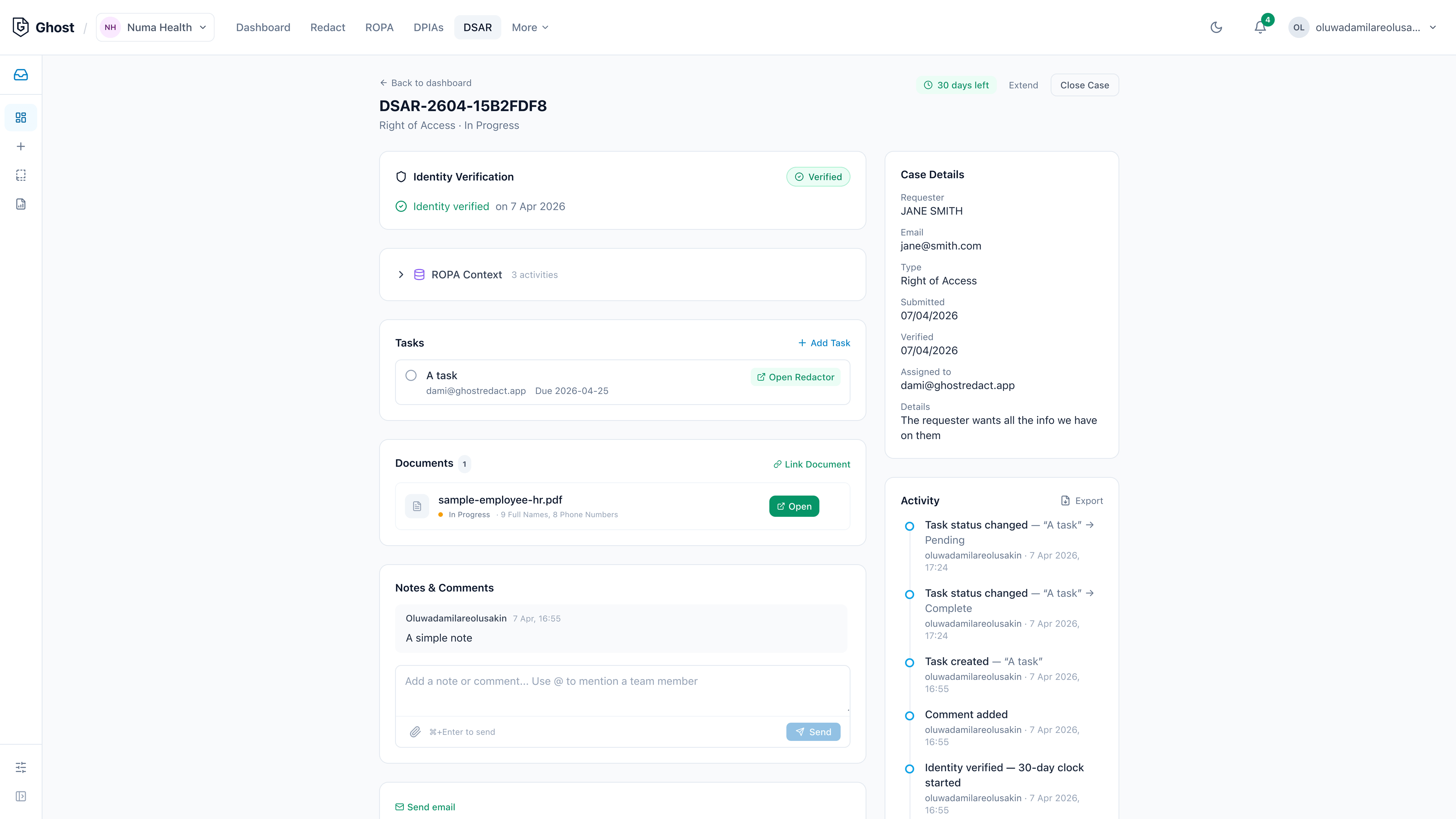
The HR DSAR workflow
Pull. Redact peers. Disclose. Evidence.
An employee — or a leaver, or a rejected candidate — asks for everything you hold. The data is spread across HRIS, ATS, payroll, the performance tool, and a manager's inbox. The work is what happens after the export. Four steps; one workspace.
Step 01
Log and verify
Intake through a branded form, verify identity before any disclosure, and start the Article 12 clock from the moment the request is identifiable.
Step 02
Pull from every system
Export from the HRIS, the ATS, payroll, the performance tool, and the manager's inbox. Ghost holds the case; the HR systems remain the systems of record.
Step 03
Redact third parties
Mask colleagues, witnesses, and peer references. Capture the rationale next to each decision. AI-assisted detection on Solo DPO and DPO Team; manual redaction on every plan.
Step 04
Deliver and evidence
Send via a signed, time-limited link. Keep an append-only audit trail of every step — intake, identity check, redaction, delivery — exportable as evidence when legal or the ICO asks.
Privacy request manager
The clock starts the moment HR logs it.
Branded intake for employees, leavers, contractors, and rejected candidates. Identity verification before disclosure. Task assignment across HR operations, HRBPs, and the recruitment team. Article 12 deadlines tracked automatically.
- Branded intake for employees, leavers, candidates
- Identity verification before any disclosure
- Tasks assignable across HR ops, HRBPs, recruiting
- Article 12 deadline tracked automatically
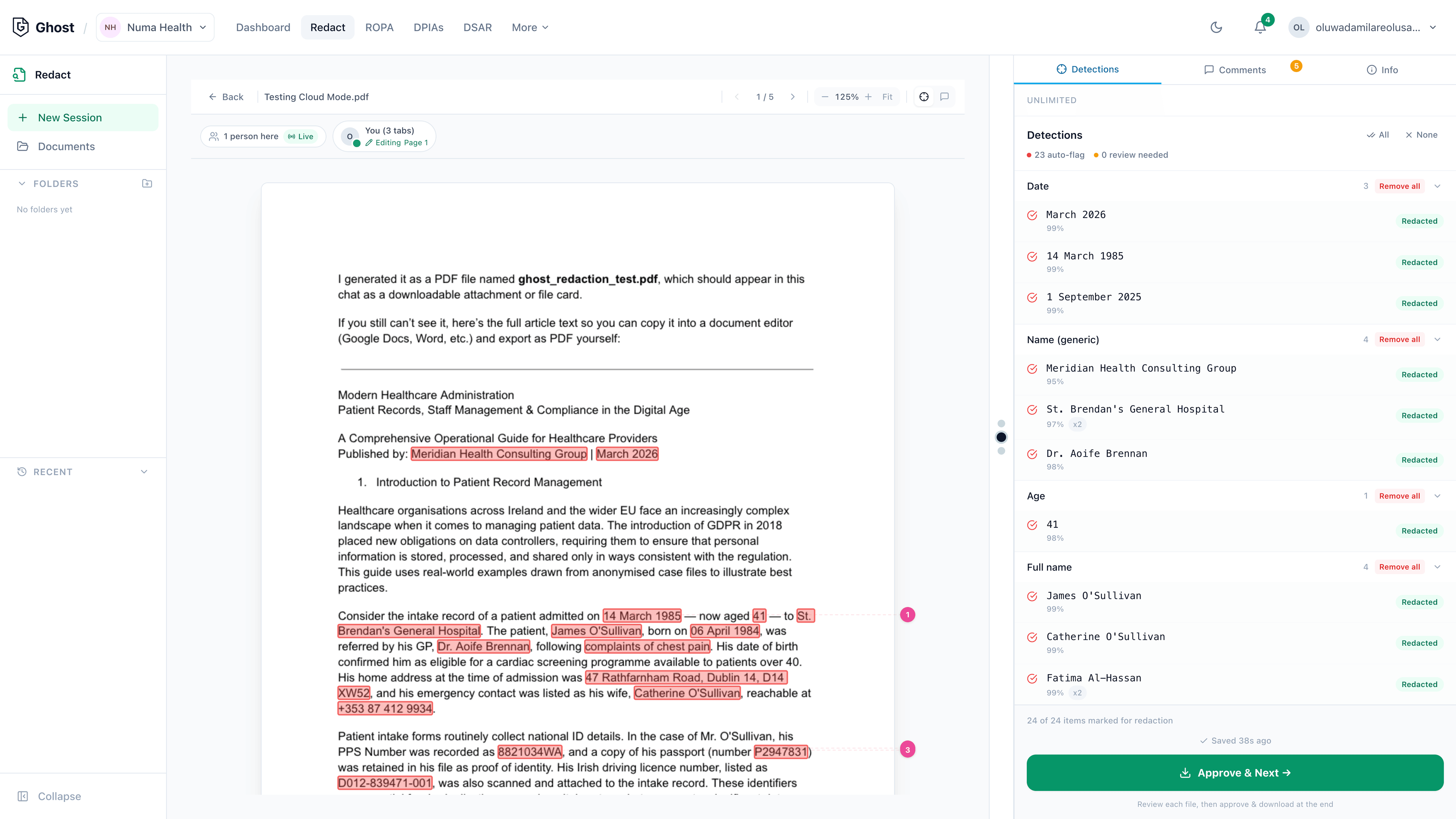
Redaction in HR files
Peer names out. The meaning stays in.
Upload grievance correspondence, performance notes, investigation files, witness statements. Ghost detects names, identifiers, contact details and proposes redactions. You accept, reject, or refine — and the rationale lands in the audit log next to the redaction.
- PDFs, CSV exports, scanned documents
- AI-assisted PII detection on Solo DPO and DPO Team
- Client-side rendering — files stay in your browser
- Rationale captured next to every redaction decision
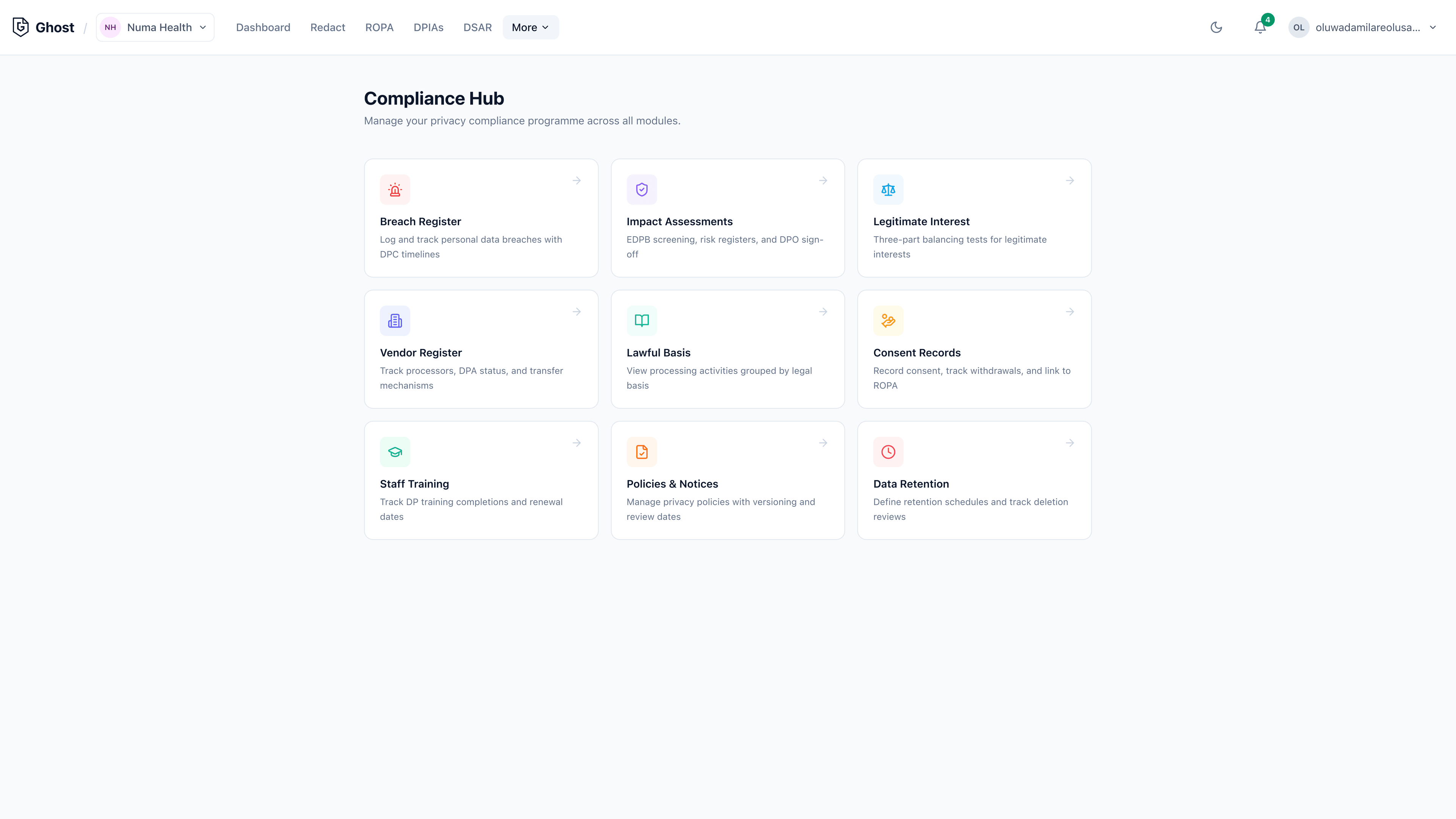
Audit log and Article 30 register
What was sent, who decided, when — already on the record.
Every disclosure, every redaction, every retention action — append-only, timestamped, attributable. Records of processing for recruitment, onboarding, payroll, performance, learning, occupational health, and leaver data. The evidence legal and the ICO ask for is already written down.
- Append-only timeline per case
- Article 30 register across the HR processing landscape
- Lawful basis and retention period on every activity
- Audit pack export when legal or the ICO asks
See it end to end
A short walk-through of the workspace.
Redaction, privacy requests, and the audit log — in about three minutes.
What HR teams ask us first
Three questions every people-ops team raises.
“We hardly ever get these.”
Most HR teams don't, until a grievance escalates or a leaver writes. The risk is that the one request that arrives is time-bound and visible to a regulator. A documented process now caps the damage.
“Our HRIS handles GDPR.”
The HRIS stores records. Ghost lives in the moment an employee asks for them — pulling exports together, redacting peer references, assembling the pack, and logging what was sent.
“What about works councils and Art. 88?”
Employment-context processing is regulated differently across member states. Ghost gives HR a single operational record across jurisdictions; the local rules live with your employment lawyer or DPO.
Pricing
Plans for HR teams of every size.
Start free. Move up when DSAR volume or complexity makes a shared inbox untenable.
Free
Run a single DSAR end-to-end before you commit.
- 1 active case
- Manual redaction (PDF, up to 5 pages/file)
- 10 redactions per month
- 1 Article 30 register entry
Solo DPO
For an HR lead or DPO running the privacy programme themselves.
- Unlimited cases and redactions
- AI-assisted PII detection
- Article 30 register + append-only audit log
- €39/mo billed annually (save 20%)
DPO Team
For HR ops, HRBPs, and the DPO sharing the response work.
- Up to 10 seats (€10/extra seat)
- Role-based access (Admin, Operator, Read-only)
- Outbound webhooks for SIEM / chat / ITSM
- Retention schedules per HR data category
- €119/mo billed annually
Compare every feature on the full pricing page.
Redacting HR documents under GDPR
A practical guide to redacting grievance, performance, and investigation files — written for HR teams who actually have to do it on a deadline.
FAQ
Frequently asked questions
The next employee DSAR is one resignation letter away.
Get the process up before it lands. 30-day free trial — no credit card, EU-hosted.
The regulatory landscape HR teams operate in
Employee personal data sits under the general regime of Regulation (EU) 2016/679 (GDPR), with the right of access under Article 15, the one-month deadline under Article 12, and the processing-record obligation under Article 30 all applying. In the UK the Data Protection Act 2018 sets the domestic regime, supervised by the ICO; the Employment Rights Act 1996 and related workplace legislation determine what HR records must be kept, and for how long.
GDPR Article 88 permits member states to lay down more specific rules for processing in the employment context. The CNIL in France, the BfDI together with the Länder authorities in Germany (where works councils typically have a co-determination role), the ICO in the UK, and other authorities each publish their own employment guidance.
HR operations is where these obligations land in practice, but legal advice usually sits elsewhere — the in-house employment lawyer, the DPO, or external counsel. Ghost is built to support that split: HR runs the operational response, legal advises on the edge cases, and the audit log records what was decided. Ghost does not provide legal advice.