The evidence behind your advice.
Captured as it happens.
Privacy advice is re-litigated long after it's given. Ghost is the contemporaneous record underneath — the lawful basis, the legitimate interest test, the DPIA sign-off, the identity verification standard — written down at the moment it was true.
EU-hosted · Append-only audit log · No privileged content stored. Counsel's files stay counsel's files.
The counsel workflow
Receive. Analyse. Sign off in record. Defend years later.
Counsel reads the proposal, asks the right questions, writes the memo. The risk is that eighteen months later the LIA is in a shared drive, the DPIA sign-off email is buried in an inbox, and the identity verification standard applied to the request that triggered the complaint is a matter of someone's memory. Ghost writes the operational facts down at the moment they're true.
Step 01
Receive
The processing proposal, the request, the incident — lands in a workspace beside the inventory. The activity is already there as a record; counsel reads in context.
Step 02
Analyse against facts
Lawful basis under Article 6. Article 9 condition where special categories apply. Legitimate interest balancing test against the activity. DPIA screening under Article 35. Each is a record, not an email.
Step 03
Sign off in the record
The LIA, the DPIA, the activity update — timestamped sign-off captured against the reviewer who made it. The advice itself stays in the legal repository; the operational decision is on the record.
Step 04
Reconstruct on demand
Eighteen months later, the LIA you ran in March is still legible — version, sign-off, facts at the time. The complaint, the regulator query, the litigation: the contemporaneous record is already written down.
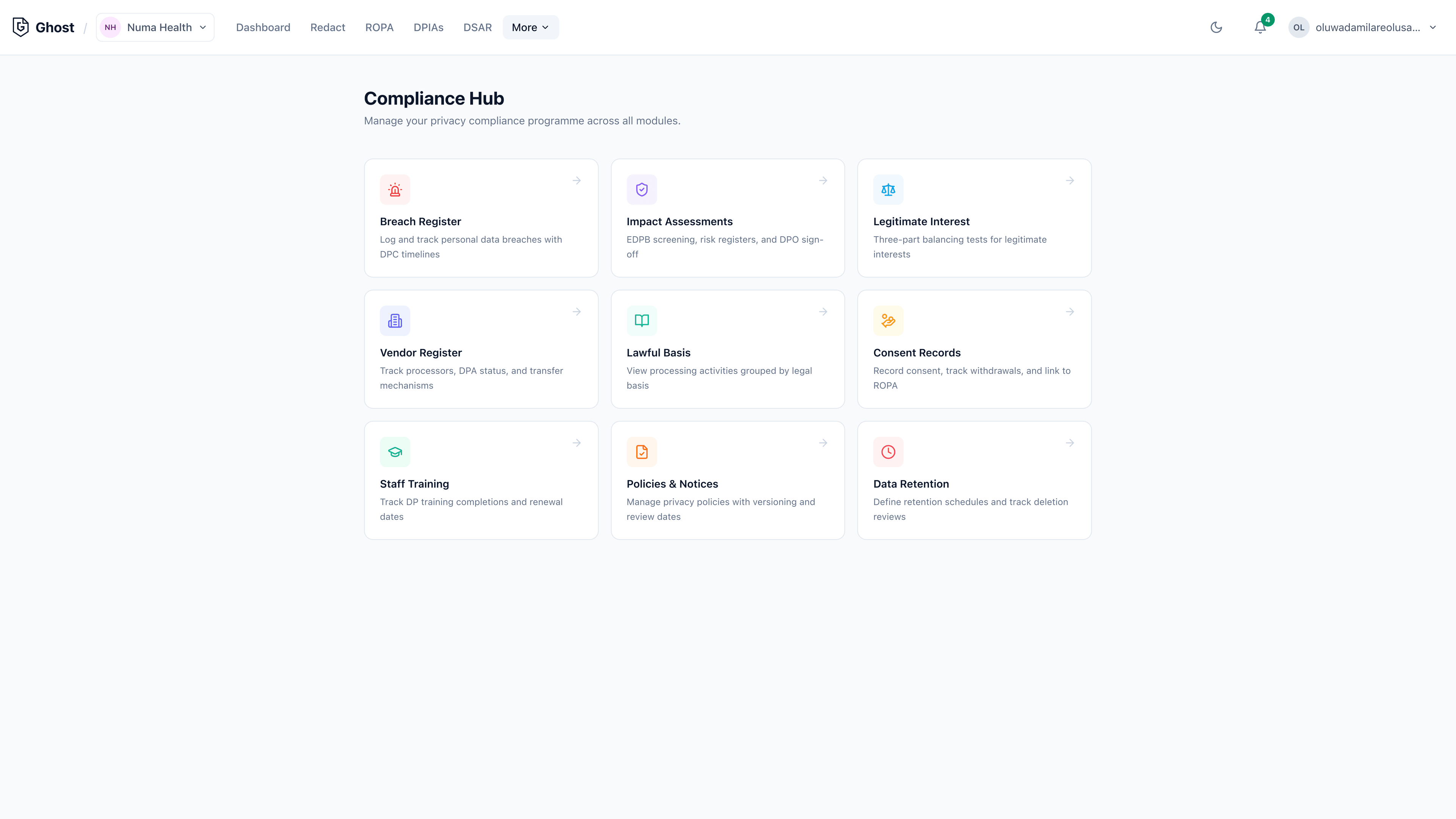
Lawful basis and LIAs
Tested at the moment. Legible years later.
Each processing activity records its Article 6 lawful basis and, where Article 9 applies, the additional condition. Legitimate Interest Assessments are structured against purpose, necessity, and balancing tests, attached to the activity, and timestamped on sign-off.
- Article 6 lawful basis per activity
- Article 9 conditions on special-category processing
- Structured LIAs tied to the activity
- Timestamped sign-off in the audit log
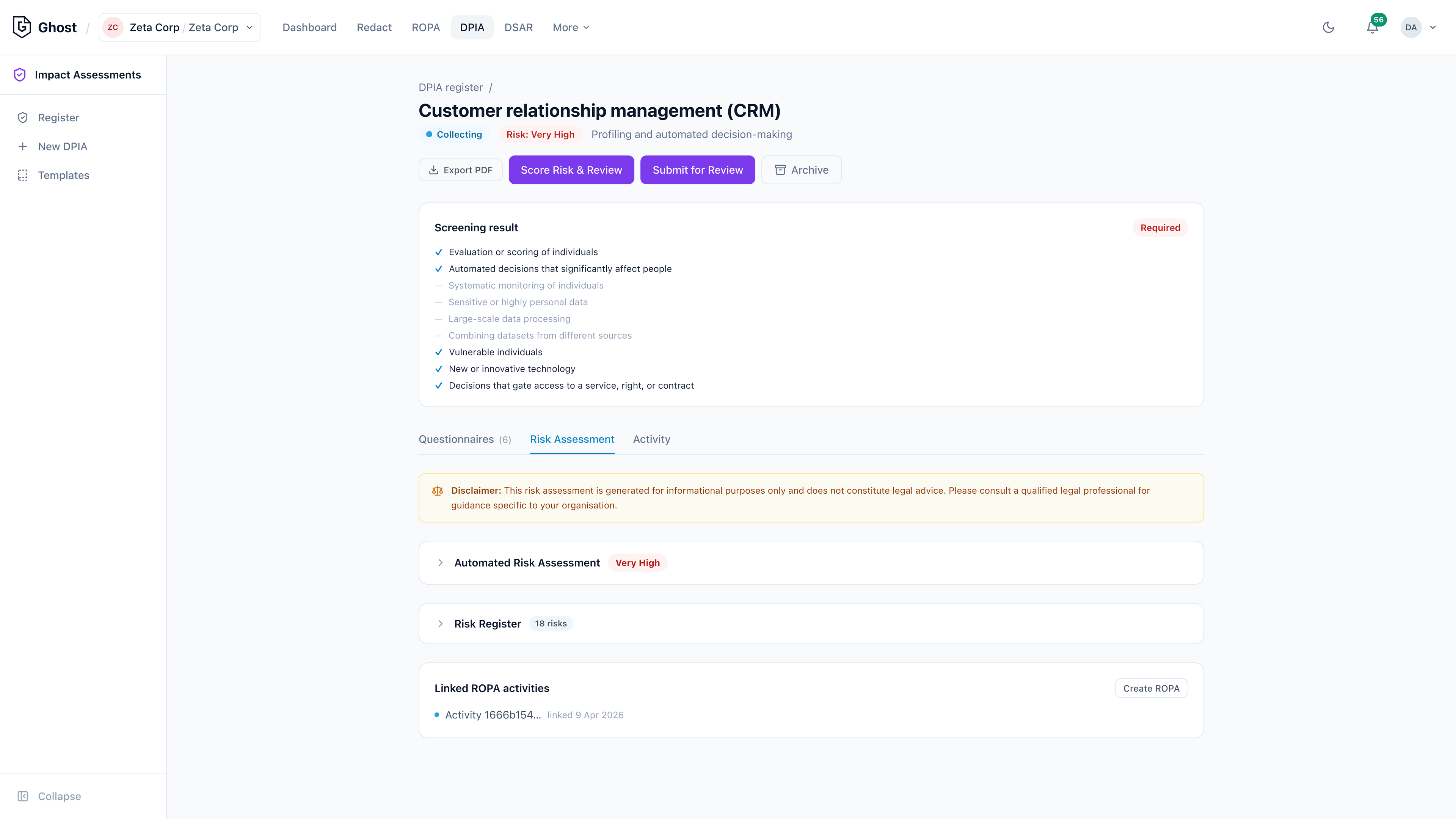
Identity verification and DSAR handling
The verification standard applied — on the record.
The Privacy Request Manager records the intake source, the identity verification standard applied, the deadline against Articles 12 and 15, the redaction decisions taken, and the delivery audit. When a complaint or regulator query arrives months later, the verification standard that was actually applied is captured.
- Intake source captured per case
- Identity verification standard recorded
- Article 12 / 15 deadline tracking
- Manual + AI-assisted redaction with rationale
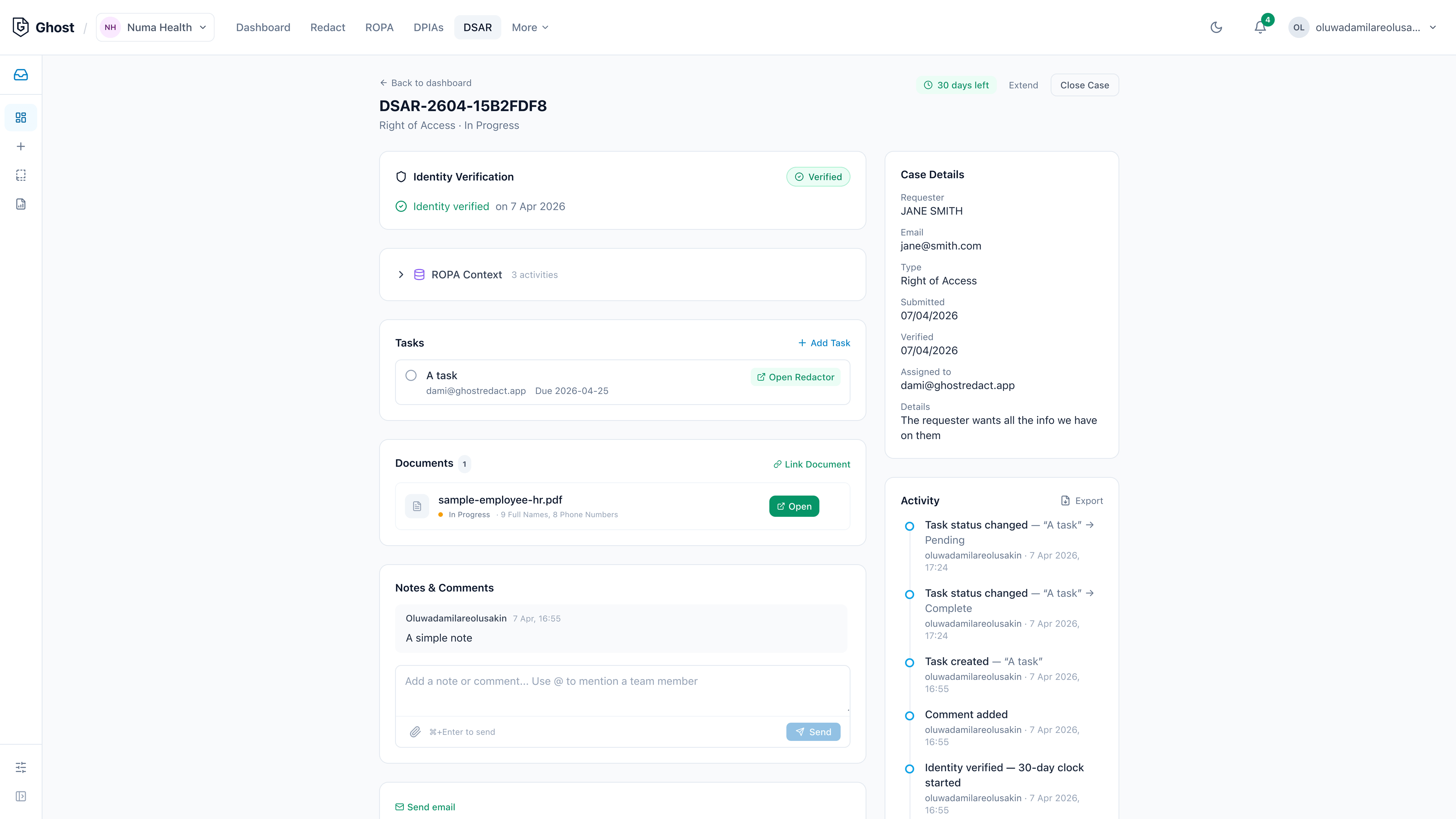
Article 30 register and audit log
The activity you advised on — still addressable years later.
The ROPA is structured around Article 30, with templates, gap analysis, annual review reminders, and PDF/Excel export. The activity counsel advised on three reviews ago is still addressable as a record, with its version history intact. The audit log captures operational facts — not legal advice.
- Article 30 register with version history
- Annual review reminders per activity
- PDF / Excel export for board and regulator
- Append-only operational audit log
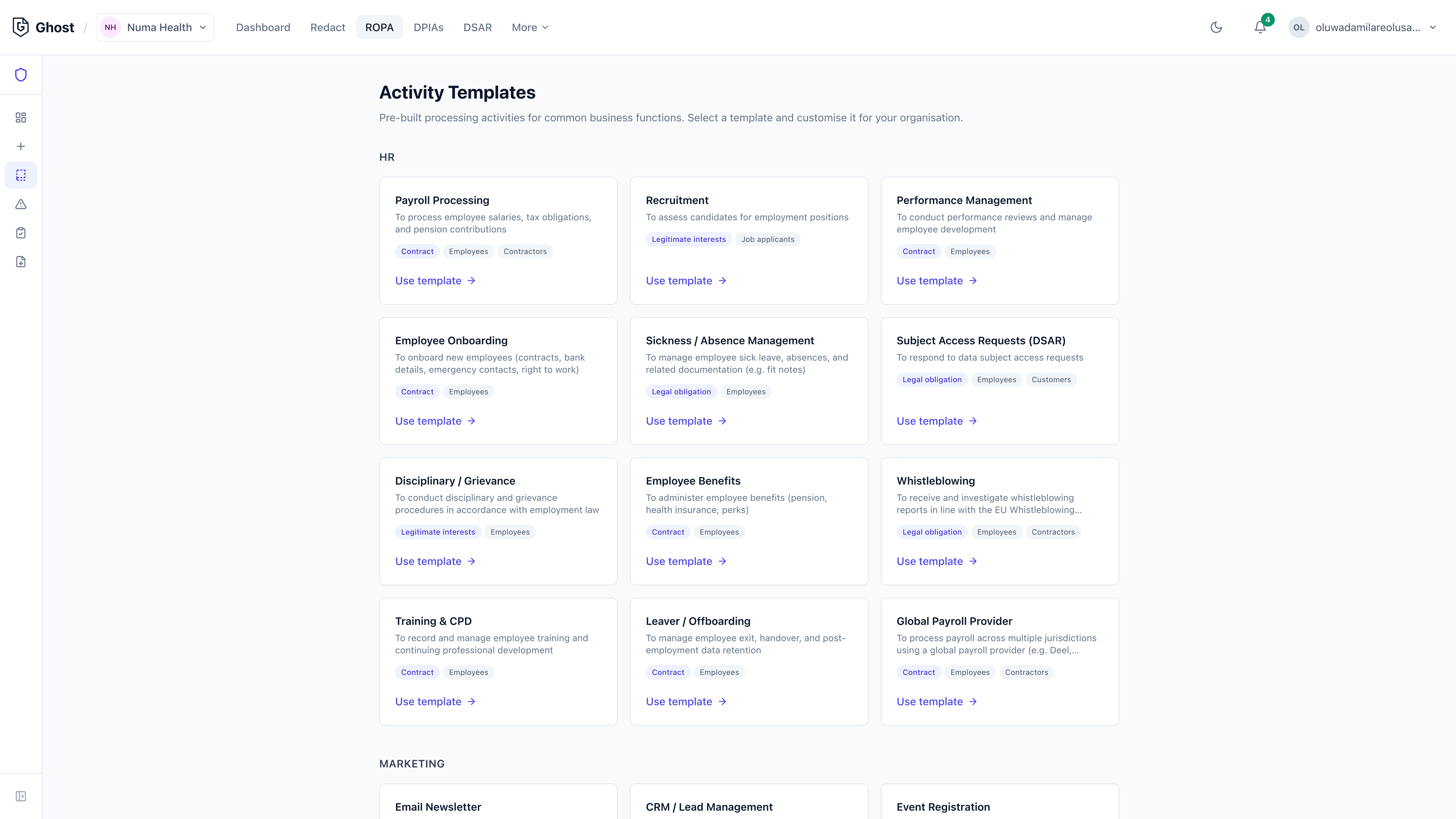
See it end to end
A short walk-through of the workspace.
Redaction, privacy requests, and the audit log — in about three minutes.
What counsel asks us first
Three questions every in-house privacy lawyer raises.
“Does this touch privileged content?”
No. Ghost stores the operational record. The advice itself — memos, external counsel correspondence — stays in the legal repository under your privilege regime. The surface is clean by design.
“Can I evidence Article 5(2) from this?”
That's what Ghost is built for. Activities, LIAs, DPIAs, DSAR audit logs, breach records — each a timestamped, append-only artefact that maps directly to the accountability obligation.
“What about US regimes?”
Configurable deadlines per intake form mean the same workspace runs a one-month GDPR clock alongside a 45-day CCPA window. The regime mapping is yours; Ghost holds the operational surface beneath.
Pricing
Plans for in-house counsel.
Start free. Bring legal, privacy, and ops into the same workspace when the programme matures.
Free
Build an LIA and run a request end-to-end before you commit.
- 1 active case
- Manual redaction (PDF, up to 5 pages/file)
- 10 redactions per month
- 1 Article 30 register entry
Solo DPO
For a single in-house counsel or fractional DPO running it all.
- Unlimited cases and redactions
- AI-assisted PII detection
- Full Compliance Hub (LIAs, DPIAs, breach, third-party)
- €39/mo billed annually (save 20%)
DPO Team
For legal, privacy, ops, and external counsel sharing the workspace.
- Up to 10 seats (€10/extra seat)
- Role-based access (Admin, Operator, Read-only)
- Configurable retention for legal-hold scenarios
- Outbound webhooks for SIEM / chat / ITSM
- €119/mo billed annually
Compare every feature on the full pricing page.
FAQ
Frequently asked questions
Advice is re-litigated. Make the record airtight.
Stand up the contemporaneous surface beneath the advice. 30-day free trial — no credit card, EU-hosted.
The regulatory landscape counsel advises across
The substantive framework is Regulation (EU) 2016/679 (GDPR) and, for UK-facing work, the UK GDPR alongside the Data Protection Act 2018. The provisions that most often produce advice work are Article 6 (lawful basis), Article 9 (special categories), Article 12 (one-month response deadline), Article 15 (right of access), Article 30 (records of processing), Article 33 (breach notification), Article 35 (DPIA), and Article 88 (employment context). Each has a documentary tail; Ghost keeps that tail attached to the record it relates to.
Supervisory authorities differ by jurisdiction. The ICO supervises the UK regime. The CNIL leads in France. The DPC is the lead authority for many large platforms established in Ireland. Counsel often advises across all three simultaneously. Ghost's outputs map to what each of these authorities expects to see when a controller's accountability under Article 5(2) is tested.
Where US regimes apply alongside — CCPA / CPRA in California and state regimes in Colorado, Virginia, Connecticut, and elsewhere — the 45-day default for US-style requests sits alongside the one-month GDPR default, configurable per intake form. Ghost does not provide legal advice; it provides the operational surface beneath the advice you're already giving.