High-volume DSARs,
on time, on the record.
A housing file, a school record, an HR file — all caught by subject access, often by FOI in parallel. Ghost is built around the subject-access side: intake, identity verification, deadline tracking, redaction, and the audit trail behind every decision.
EU-hosted · Append-only audit log · Designed for procurement scrutiny on residency.
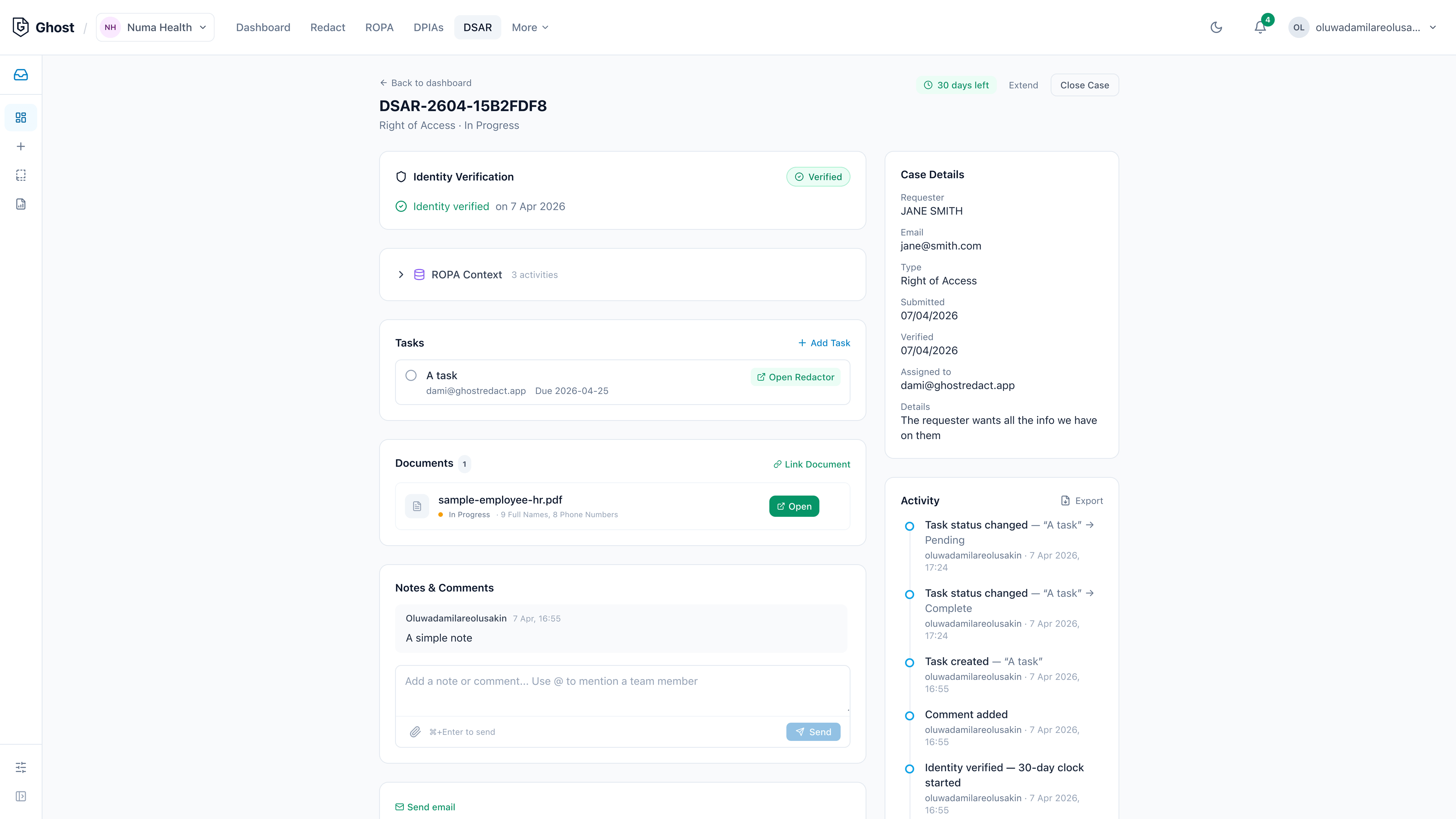
The information rights workflow
Log. Locate. Redact. Disclose.
A resident asks for their housing file. A parent asks for their child's social work record. A leaver asks for their HR file. The work is the same shape every time — and the trail has to survive challenge, internal review, and an ICO query.
Step 01
Log and verify
Intake through a branded form. Verify identity before any disclosure. The one-month statutory clock under Article 12 starts the moment the request is identifiable.
Step 02
Locate across service areas
Pull records from the relevant service area systems — housing, social care, education, HR. Ghost holds the case; the records management systems remain the systems of record.
Step 03
Redact third parties and exempt material
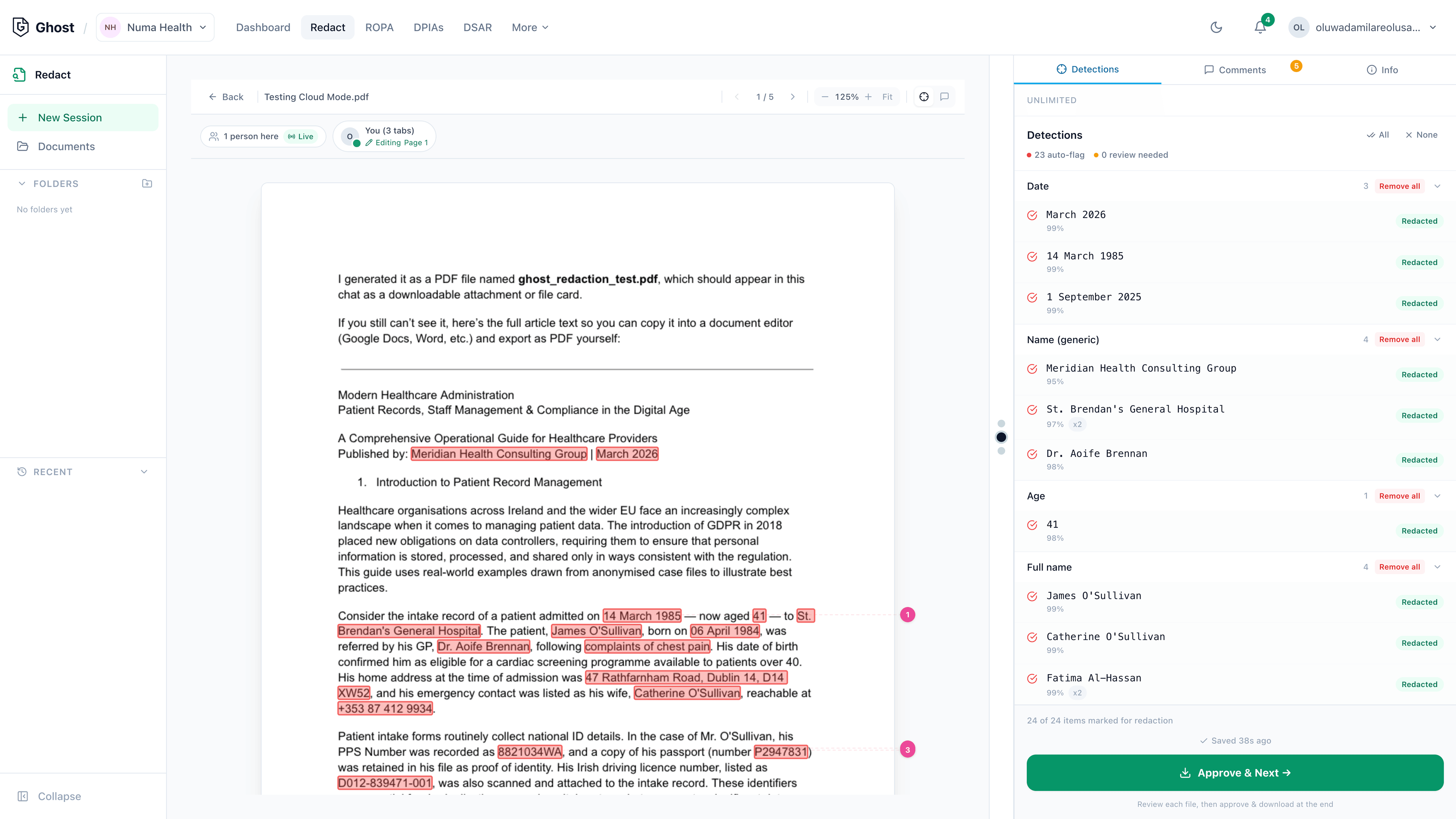
Mask third-party identifiers and exempt content. Capture the rationale next to every redaction. AI-assisted detection on Solo DPO and DPO Team; manual redaction on every plan.
Step 04
Disclose and evidence
Send via a signed, time-limited link. Keep an append-only audit trail of every step — exportable as evidence when internal review or the ICO asks.
Privacy request manager
Built around the statutory clock — including complex-case extensions.
Branded intake for requesters and representatives, identity verification before any disclosure, task assignment across service areas, and automatic deadline tracking with optional clarified extensions for complex requests.
- Branded intake for requesters and representatives
- Identity verification before any disclosure
- Tasks assignable across service areas
- Clarified Article 12(3) extensions captured on the case
Manual and AI-assisted redaction
Third parties out. Exempt material out. Defensibly.
Upload exports from line-of-business systems, scanned correspondence, and case files. AI-assisted detection surfaces likely third-party names, addresses, and identifiers for human review. You accept, reject, or refine — and the rationale lands in the audit log.
- PDFs, scanned correspondence, CSV exports
- AI-assisted PII detection on Solo DPO and DPO Team
- Client-side rendering — files stay in your browser
- Rationale captured next to every redaction decision
Append-only audit log
Every acknowledgment, every decision — already written down.
Records of processing aligned to Article 30 across service delivery, employee data, statutory functions, and shared processing. An append-only audit log of every intake, clarification, redaction decision, internal review note, and final response. When an ICO investigator or internal reviewer asks how a decision was reached, the chain is already there.
- Article 30 register across service areas
- Lawful basis under Art. 6 and Art. 9 on every activity
- Append-only timeline per case
- Audit pack export when internal review or the ICO asks
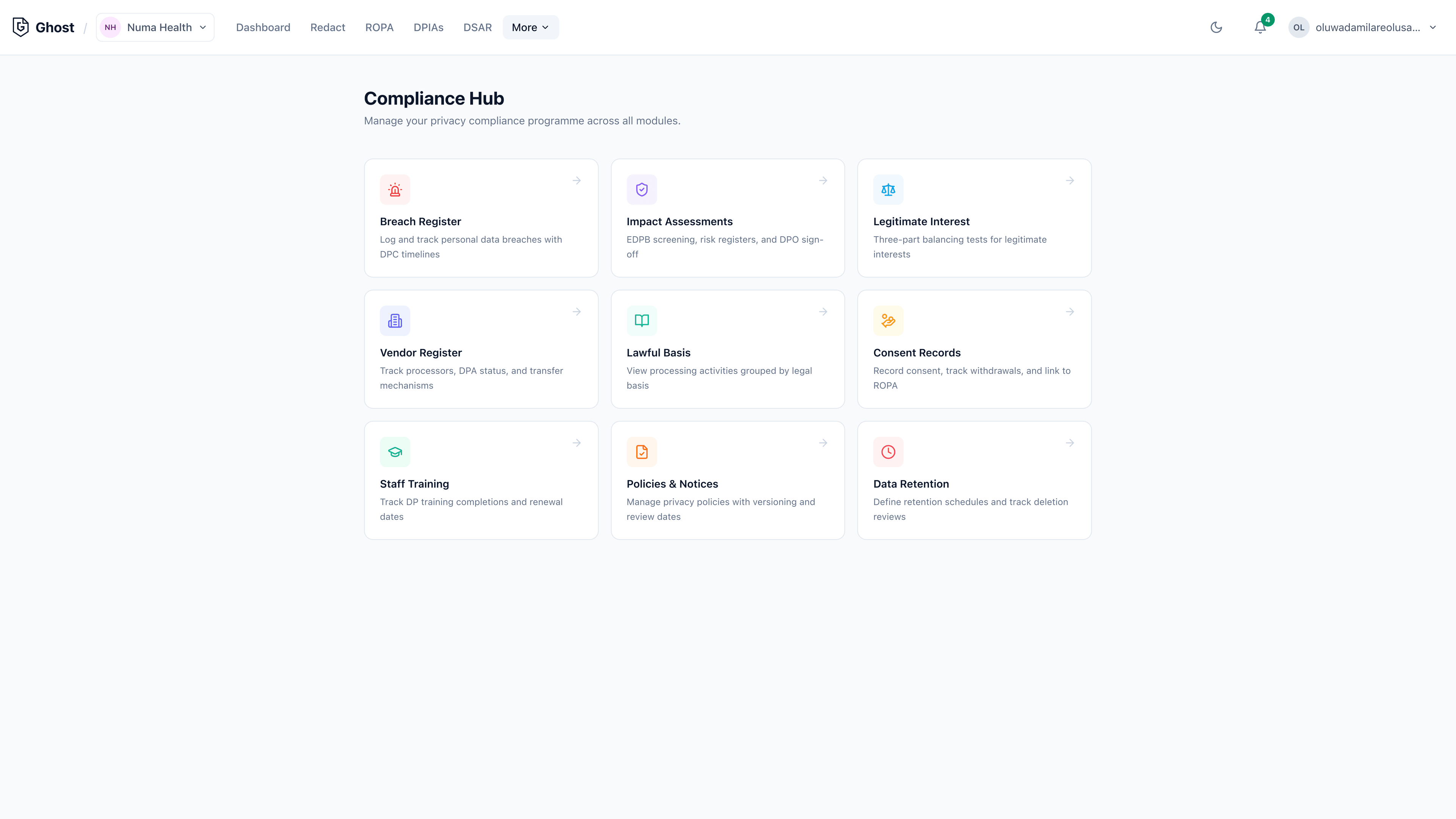
See it end to end
A short walk-through of the workspace.
Redaction, privacy requests, and the audit log — in about three minutes.
What public sector teams ask us first
Three questions every IG team raises.
“Where does FOI fit?”
Ghost is built for subject access, not FOI. FOI runs in parallel and has its own deadlines, exemptions, and review routes — a dedicated FOI tool is the right home for that workflow. Ghost lives next to it.
“What about residency for procurement?”
EU-hosted data centres, encryption in transit and at rest, an append-only audit log, time-limited disclosure links, and configurable retention. The full architecture is documented for procurement review.
“Does this replace our records management system?”
No. The records management system stays the system of record. Ghost is the privacy operations layer beside it — for the request, the redaction, and the audit trail.
Pricing
Plans for small, mid, and large authorities.
Start free. Engage with us for procurement-specific arrangements at larger scale.
Free
Run a single subject access request end-to-end before you commit.
- 1 active case
- Manual redaction (PDF, up to 5 pages/file)
- 10 redactions per month
- 1 Article 30 register entry
Solo DPO
For a single information governance lead running the programme themselves.
- Unlimited cases and redactions
- AI-assisted PII detection
- Article 30 register + append-only audit log
- €39/mo billed annually (save 20%)
DPO Team
For information rights teams sharing the work across service areas.
- Up to 10 seats (€10/extra seat)
- Role-based access (Admin, Operator, Read-only)
- Outbound webhooks for SIEM / chat / ITSM
- Procurement evidence pack on request
- €119/mo billed annually
Compare every feature on the full pricing page.
FAQ
Frequently asked questions
The DSAR backlog never gets smaller on its own.
Stand up the workflow before the next batch lands. 30-day free trial — no credit card, EU-hosted.
The regulatory landscape public bodies operate in
Two regimes sit at the centre of the work. The UK GDPR (the Regulation as retained in UK law) and the Data Protection Act 2018 govern personal data, including the right of access under Art. 15, the deadlines and transparency obligations under Arts. 12–14, and the processing-records and breach-notification obligations under Arts. 30 and 33. The Freedom of Information Act 2000 (England, Wales, and Northern Ireland) and the Freedom of Information (Scotland) Act 2002 govern information held by public authorities, with a twenty-working-day response window and a separate set of exemptions and public-interest tests.
Where a public body carries out law enforcement processing — policing, prosecuting authorities, certain regulatory functions — Part 3 of the Data Protection Act 2018 applies in place of the UK GDPR for that processing, with its own rules on data-subject rights and disclosure. Statutory disclosure regimes in housing, social care, and education often run in parallel against the same files. Public-records legislation governs retention and eventual transfer to a place of deposit.
Ghost is the privacy operations layer beside these regimes, not the records management system itself and not a substitute for legal judgement on exemptions, redaction tests, or internal review outcomes. Ghost does not provide legal advice — speak to your information governance lead, monitoring officer, or counsel about how each regime applies to a specific request.