Privacy at platform scale.
Tenant-aware.
You're a controller of your customers' employees and a processor of their end users on the same day, against the same backend. Ghost is built for the split — public intake, controller and processor flows kept separate, sub-processor register customers can be pointed at.
EU-hosted · Append-only audit log · Outbound webhooks · Configurable deadlines per regime.
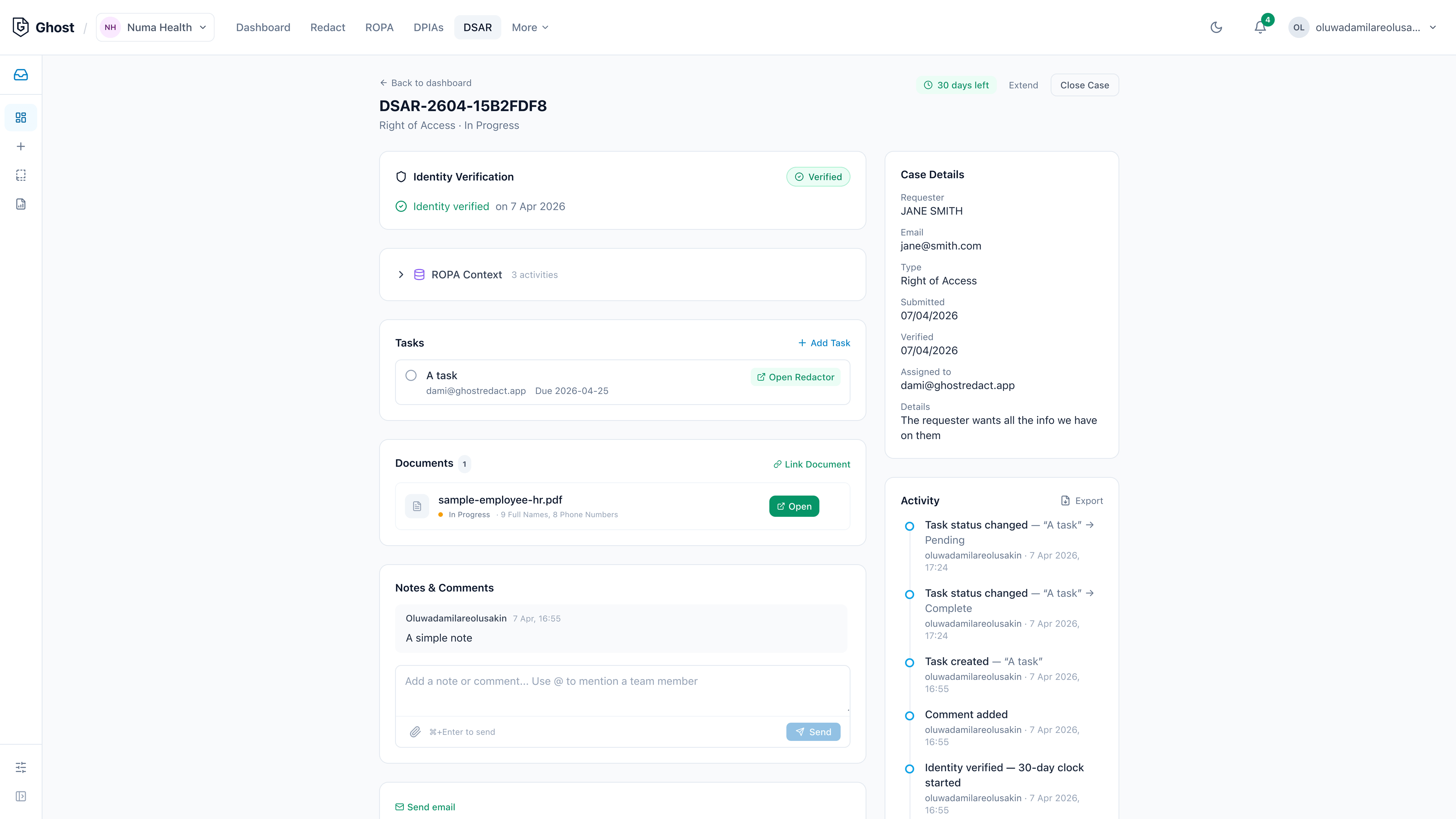
The platform privacy workflow
Intake. Scope. Redact. Deliver.
End users hit the intake form. The case routes to the right flow — controller or processor, GDPR or CCPA. Ghost holds the deadline, the redaction, the disclosure, and the audit trail customers and procurement keep asking about.
Step 01
Intake (per regime)
Branded, embeddable intake forms with the right deadline rules per matter — one-month GDPR on one, 45-day CCPA on another. Identity verification before disclosure.
Step 02
Scope: controller or processor
Requests against the platform's own data run as controller flows. Requests forwarded by a customer against their tenant run as processor flows — customer named, tenant scoped, response routed back.
Step 03
Redact inside the export
Mask end-user identifiers, third parties, and free-text personal data caught up in the response pack. AI-assisted detection on Solo DPO and DPO Team; manual redaction on every plan.
Step 04
Deliver and evidence
Time-limited disclosure link. Append-only audit log of every step. Outbound webhooks (DPO Team) for SIEM, chat, or ITSM destinations.
Public intake for end users
A request route that scales past a shared inbox.
Branded, embeddable intake that sits on your platform's privacy page or trust centre. End users select the request type. Deadlines are configurable per intake form so a single deployment handles multiple regimes without the operator remembering which is which.
- Brandable, embeddable intake form
- Identity verification before any disclosure
- Configurable deadlines per regime
- Tenant scoping and processor routing
Redaction inside the response pack
Free-text PII caught and cleared, in your browser.
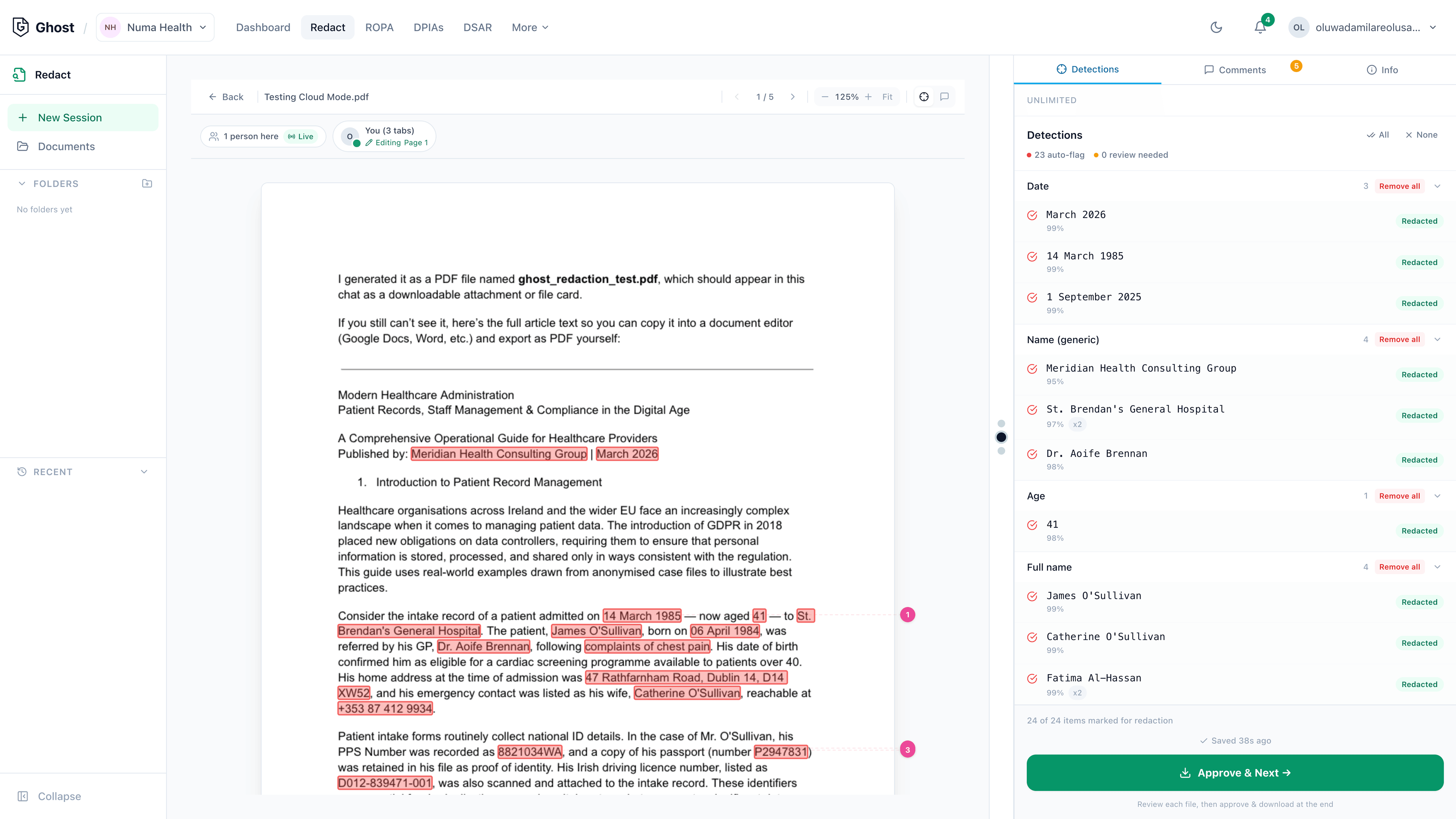
Upload CSV exports, PDF reports, free-text fields. Ghost detects names, identifiers, and contact details inline. PDF rendering and redaction are client-side; files do not leave the browser. AI-assisted detection on Solo DPO and DPO Team for first-pass review.
- PDFs, CSV exports, scanned documents
- AI-assisted PII detection on Solo DPO and DPO Team
- Client-side rendering — files stay in your browser
- Rationale captured next to every redaction
Sub-processor register and audit log
Procurement answers from the same source ops maintains.
The Third-Party Register holds your sub-processors, data categories, regions, and transfer mechanisms. The Article 30 register covers controller and processor sides. Append-only audit log on every intake, identity check, disclosure, and register update.
- Sub-processor register customers can be pointed at
- Article 30 register for controller and processor flows
- Append-only audit log per case and per record
- Webhook export to SIEM, chat, or ITSM (DPO Team)
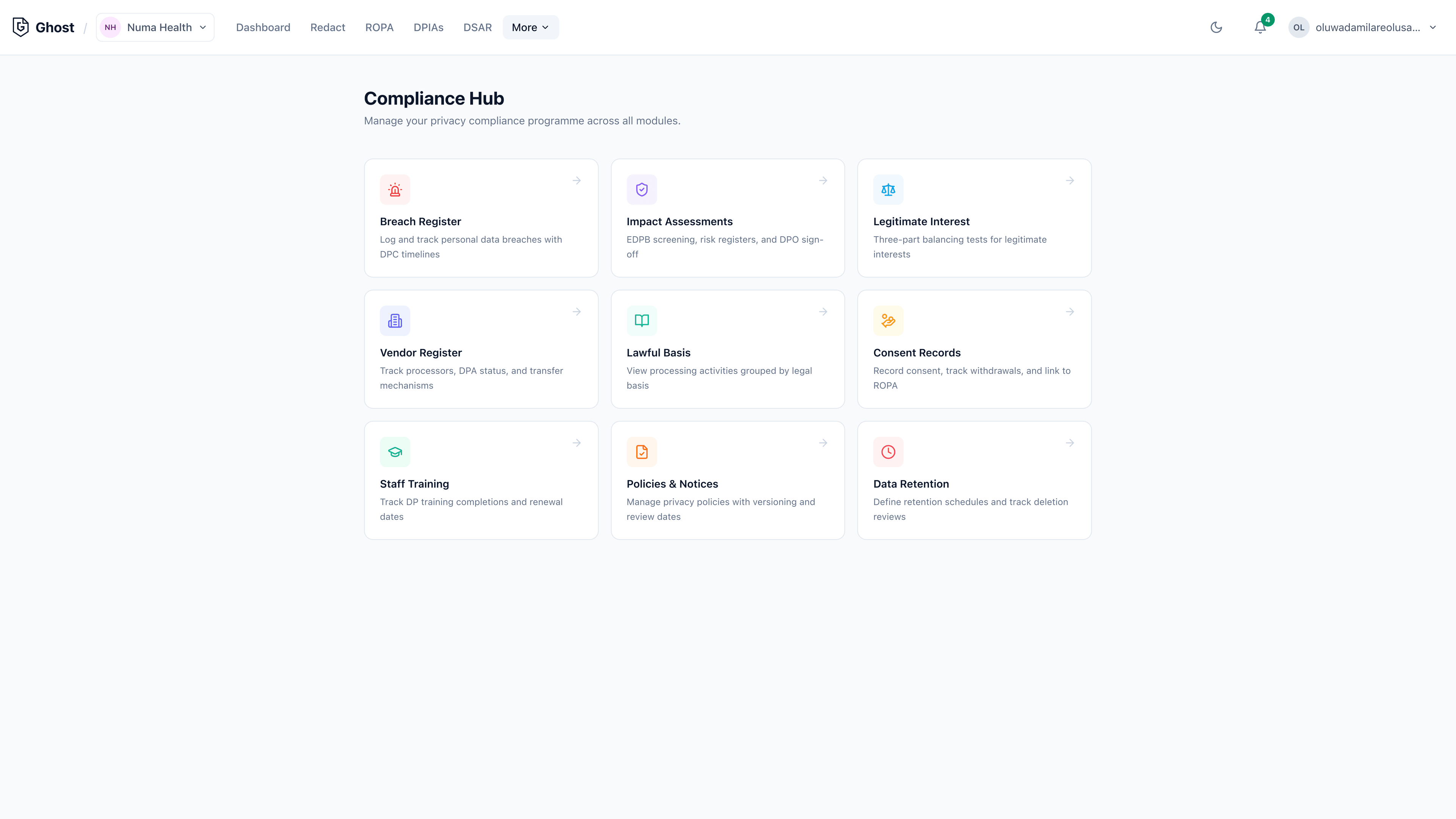
See it end to end
A short walk-through of the workspace.
Redaction, privacy requests, and the audit log — in about three minutes.
What platform teams ask us first
Three questions every SaaS privacy lead raises.
“Does this handle our processor side?”
Yes. Requests forwarded by a customer against their tenant run as processor flows — customer named, tenant scoped, response routed back. Controller and processor flows share infrastructure but stay separated.
“Can we plug events into our own systems?”
On DPO Team. Workspace events are delivered outbound to Slack, Teams, or a custom HTTPS endpoint of your choice. Endpoint URLs are vault-stored secrets; delivery is logged.
“What about our sub-processor list?”
The Third-Party Register holds your sub-processors, data categories, regions, and transfer mechanisms. The list customers are pointed at during procurement is the same list ops maintains. One source.
Pricing
Plans for SaaS at every stage.
Start free. Scale when end-user volume — or customer procurement — requires it.
Free
Run a single end-user request end-to-end before you commit.
- 1 active case
- Manual redaction (PDF, up to 5 pages/file)
- 10 redactions per month
- 1 Article 30 register entry
Solo DPO
For a single privacy or trust lead running the programme themselves.
- Unlimited cases and redactions
- AI-assisted PII detection
- Article 30 register + append-only audit log
- €39/mo billed annually (save 20%)
DPO Team
For privacy, ops, support, and security sharing the response work.
- Up to 10 seats (€10/extra seat)
- Role-based access (Admin, Operator, Read-only)
- Outbound webhooks for SIEM / chat / ITSM
- Sub-processor register + DPA evidence pack
- €119/mo billed annually
Compare every feature on the full pricing page.
DSAR redaction at platform scale
Practical guidance on running end-user privacy requests across controller and processor flows — written for SaaS operations teams.
FAQ
Frequently asked questions
The next security questionnaire is in someone's inbox.
Stand up the surface customers and end users actually use. 30-day free trial — no credit card, EU-hosted.
The regulatory landscape platform teams operate in
The General Data Protection Regulation (Regulation (EU) 2016/679) sets the baseline most SaaS platforms work to. Article 4 defines the controller and processor roles the platform sits in simultaneously; Article 28 sets the contractual obligations between them and is the basis for the data processing addendum customers ask to sign. Articles 12 and 15 set the access workflow and its one-month default, Article 30 the records of processing, Article 33 the 72-hour breach notification, and Article 35 the DPIA. In the UK, the Data Protection Act 2018 sets the domestic regime, supervised by the ICO.
In the United States, the California Consumer Privacy Act (CCPA) as amended by the California Privacy Rights Act (CPRA) sets a separate workflow with a 45-day default response window, administered by the California Privacy Protection Agency (CPPA). Other state regimes have followed and now sit alongside it — Colorado, Connecticut, Virginia, Utah, Texas, and others. Ghost supports configurable deadlines per intake form so a single platform can route requests under each regime without a separate intake for each.
Ghost does not provide legal advice. The mapping between a platform's product, its customer base, and the regimes that apply is a question for the privacy lead and counsel.